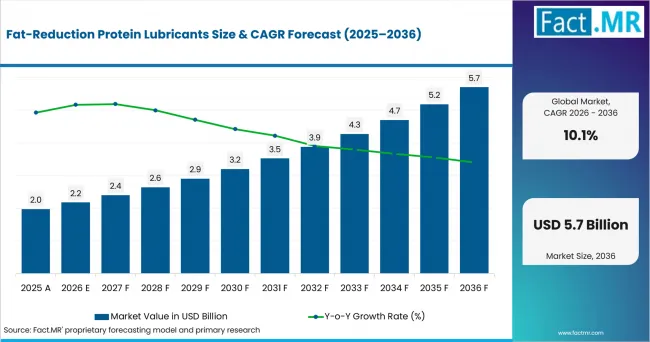
The Fat-Reduction Protein Lubricants Market is projected to grow significantly, with a valuation of USD 2.0 billion in 2025 expected to increase to USD 2.2 billion in 2026. By 2036, the market is forecasted to reach USD 5.7 billion, reflecting a compound annual growth rate (CAGR) of 10.1% over the period from 2026 to 2036.
Read More
Key growth drivers include increased demand from various sectors such as dairy, beverages, sauces, and baking. Dairy developers seek proteins that restore creaminess after fat reduction while maintaining smoothness. Similarly, beverage makers require proteins that disperse well and retain stability, while sauce manufacturers need emulsification properties to keep oil and water mixed effectively. Additionally, bakery producers aim for moisture retention and a soft texture when fat is reduced.
The market analysis reveals that whey proteins are anticipated to command a 34.0% market share in 2026. The lubrication and creaminess functional role is projected to account for 31.0% of the market, while dairy and alternative applications are expected to comprise 36.0% of the market share.
Analysts at Fact.MR highlight the importance of pairing protein choices with clear testing and usage guidance to meet sensory and nutritional needs. Major markets are expected to have varying growth rates. For instance, China is projected to achieve an 11.6% CAGR, driven by robust dairy output and packaged food reformulations. Japan follows closely with a 10.5% CAGR, benefiting from advanced food processing practices. The USA and France are set at a 10.1% growth rate, with the USA's extensive food spending supporting the market.
Further analysis suggests that while there are drivers supporting market growth, such as protein enrichment for texture, there are also challenges like concerns over taste at higher protein levels and rising raw material costs. Despite these hurdles, the market for fat-reduction protein lubricants remains poised for substantial growth as consumer preferences shift towards lower-fat food options without sacrificing quality.