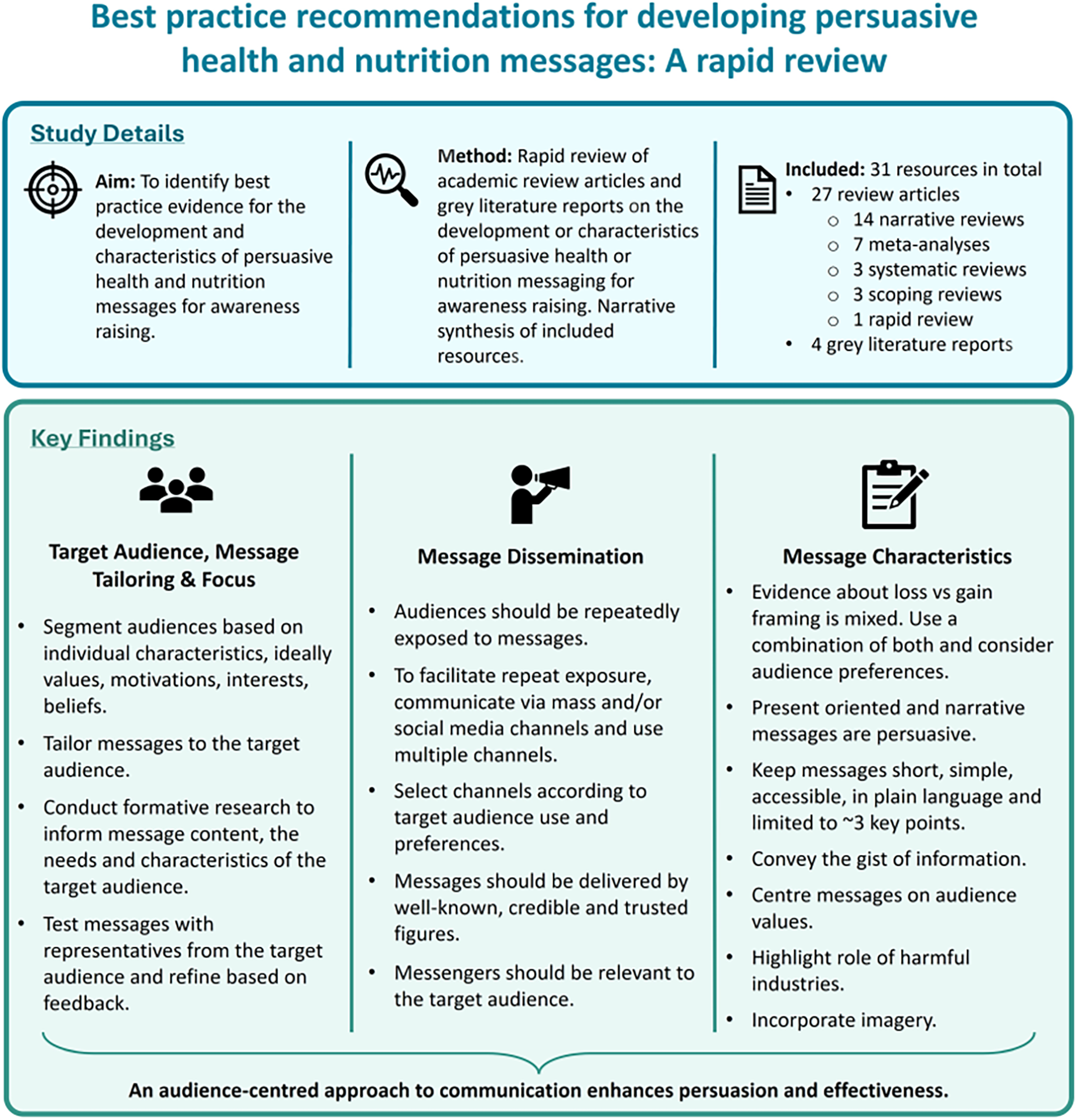
Modifiable health behaviors, particularly poor dietary patterns, significantly contribute to the global burden of disease. Effective messaging about health and nutrition plays a crucial role in raising awareness and fostering behavior change towards healthier diets. This rapid review aims to systematically identify the best practices and evidence for developing persuasive health and nutrition messages aimed at adults.
Read More
The review focused on academic reviews and grey literature published in English since 2010, specifically addressing the development and characteristics of general health and nutrition messaging for awareness raising. A comprehensive search was conducted across databases such as MEDLINE Complete, CINAHL, and Embase from April to July 2024, leading to the inclusion of 31 records from 12,507 initial results.
Findings indicate consistent support for an audience-centered approach to messaging, which includes audience segmentation, message tailoring, and testing with target demographics. It is recommended that messages be disseminated through diverse channels, including mass and social media, to ensure repeated exposure. Best practices in message development emphasize the use of narratives, simple language, succinctness, focus on the overall message rather than details, and the incorporation of imagery to enhance persuasiveness.
Unhealthy diets and other modifiable behaviors contribute to non-communicable diseases on a global scale. Although systems-level strategies are essential for promoting healthy behaviors, effective communication of health and nutrition messages remains crucial, as highlighted by organizations like the World Health Organization (WHO).
Challenges in health and nutrition communication include the prevalence of misleading advertisements for unhealthy products, which overshadow public health initiatives. Additionally, widespread misinformation contributes to distrust in scientific authorities, impeding message acceptance and adherence to healthy guidance.
This review's results underscore the importance of persuasive messaging in public health nutrition, particularly the necessity for messages to be well-accepted to induce changes in beliefs or behaviors. Effective messaging considers various characteristics, such as tone, framing, and delivery methods, to enhance receptivity.
The review methodology adopted a rapid review approach, simplifying standard systematic review procedures to expedite findings. Only academic reviews and relevant grey literature reports were screened and analyzed to derive recommendations for best practices in health and nutrition communication.
Among the 31 included records, a notable portion emphasized the effectiveness of tailored messaging for defined audience segments, supported by formative research and stakeholder engagement. Practical recommendations for dissemination suggest multi-channel approaches that incorporate social media strategies effectively.
Key message characteristics identified include narrative engagement, accessible language, emotional resonation, and visual elements, all vital in fostering acceptance and persuasiveness. Notably, narratives can enhance retention and impact more than traditional statistical messaging. The review found that employing imagery that reflects cultural relevance and relatability also improves message engagement.
This synthesis of evidence is crucial for guiding effective health and nutrition communication strategies that address the growing burden of preventable diseases. Future research should explore innovative approaches to health messaging, including influencer partnerships and digital audience segmentation, while being mindful of ethical considerations in public health communications.