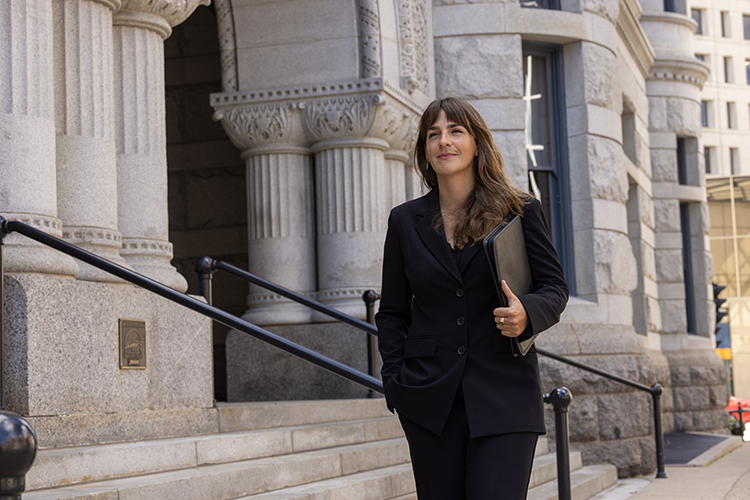
Sunny Schneider, an employee in law enforcement for the villages of Pewaukee and Summit, is pursuing a master’s degree part-time at the University of Wisconsin-Milwaukee (UWM) to advocate for changes in the mental health system. Her goal is to work with lawmakers and other stakeholders to improve mental health services in Wisconsin.
Read More
Growing up in Watertown, Schneider faced challenges related to her father’s bipolar disorder and substance abuse issues. At 17, she enlisted in the military, serving in Germany and Iraq before completing her bachelor's degree in history. After the death of her father in 2018, she decided to join the police academy, drawn to public service once again.
Schneider began her career with the Waukesha Police Department in August 2019. As the COVID-19 pandemic intensified, the department experienced an increase in 911 calls related to mental health crises, prompting Schneider to reflect on her personal experiences. She noted, “I was good at de-escalating situations and always gravitated toward those mental health calls,” recalling the people that reminded her of her father.
In response to the growing need for supportive care in crises, Schneider led the establishment of the Waukesha Police Department’s Crisis Response Unit in 2022. This unit involved a police officer collaborating with a county mental health worker to address mental health emergencies. The initiative received recognition for its effectiveness, and Schneider continued her involvement until January 2026, seeking to transition to a broader leadership role.
Currently enrolled in UWM’s Master of Healthcare Administration and Master of Business Administration dual degree program, Schneider appreciates that UWM offers Wisconsin’s only accredited Master of Healthcare Administration degree. She plans to complete her studies part-time and online while looking forward to an internship at a Milwaukee hospital.
“My goal is to understand all the stakeholders around mental health in Wisconsin,” Schneider said, aiming to bring them together to develop solutions. She has expressed interest in reforming statute 51.15, a law allowing emergency mental health detentions, and previously collaborated with the Mental Health Action Partnership to propose best practices for its implementation.
Through her coursework at UWM, Schneider is gaining analytical tools, like systems thinking and the “Five Whys” method, which helps identify root causes of complex problems. She has found support from Melissa Armstrong, clinical associate professor and graduate director at UWM, and has been appointed to Chancellor Thomas Gibson’s Committee on Mental Health and the Student Wellness Advisory Group.
After graduation, Schneider aspires to take on a state-level role that allows her to affect policy change for mental health care. While acknowledging the challenges that lie ahead, she hopes to make meaningful improvements, particularly for individuals with experiences similar to her father's. “My father never intended to be my greatest teacher, but he was,” she reflected, noting his profound impact on her life and ambitions.