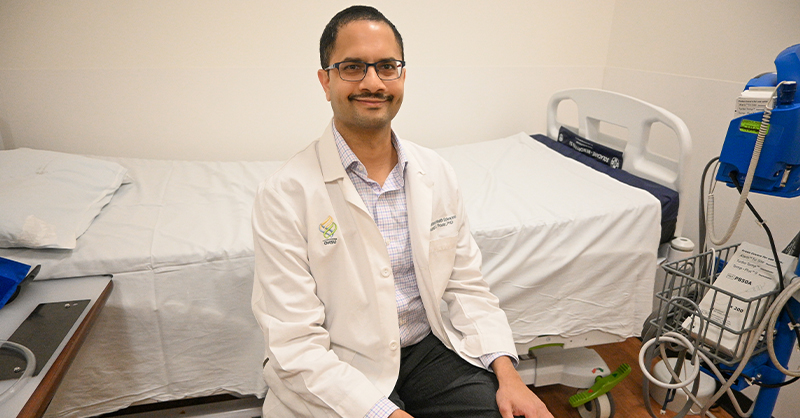
A study led by OHSU sleep scientist Saurabh Thosar, Ph.D., highlights a connection between obstructive sleep apnea and nighttime impairment of blood vessel function. This impairment may contribute to a higher risk of heart attacks during the night for individuals with sleep apnea.
Read More
Conducted at Oregon Health & Science University, the research emphasizes the significance of monitoring vascular health in this patient population. Thosar noted, "This study clearly shows nighttime impairment of blood vessel function driven by the body’s internal clock in people with untreated obstructive sleep apnea."
Published in the Journal of the American Heart Association, the study indicates that while cardiovascular events like heart attacks generally occur soon after waking in the broader population, patients with sleep apnea experience these events more frequently throughout the night. The findings suggest a link between nighttime vascular function impairment and the heightened risk.
The research involved 12 participants diagnosed with obstructive sleep apnea, who spent five nights in a sleep laboratory at OHSU’s Marquam Hill campus. Careful control of exercise, meals, and sleep patterns allowed researchers to measure vascular function throughout a full 24-hour circadian cycle. Using non-invasive ultrasound, blood vessel function was assessed during ten recurring sleep cycles of approximately 5 hours and 20 minutes.
Results revealed disruption of the body's natural circadian rhythm, with the most significant blood vessel impairment observed around 3 a.m. in participants with sleep apnea. Thosar stated, "This is the first study to show the circadian system impairs blood vessel function in people with obstructive sleep apnea."
Future research may focus on whether timed medication can enhance vascular health and decrease nighttime cardiovascular risk in these patients. The standard treatment for sleep apnea is continuous positive airway pressure (CPAP), though some individuals find it intolerable. For these patients, potential alternatives could include taking antioxidants or related medications before bedtime.
Thosar's co-authors include Nicole Bowles, Matthew Butler, Andrew McHill, Sean Rice, Jonathan Emens, and senior author Steven Shea, all from the Oregon Institute of Occupational Health Sciences at OHSU. This study received support from the National Heart, Lung, and Blood Institute and the National Center for Advancing Translational Sciences, with various NIH grant numbers.