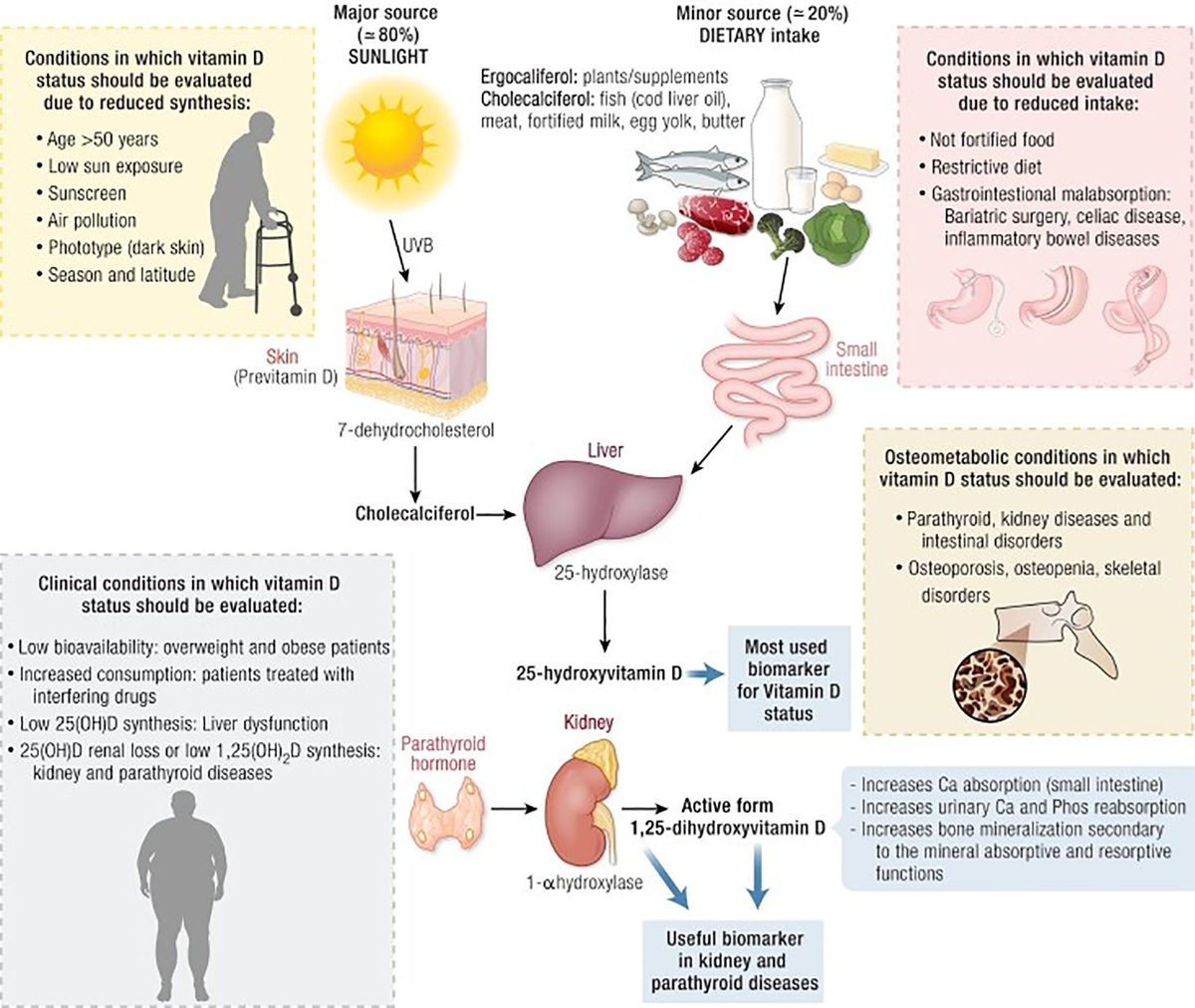
Vitamin D is a group of fat-soluble vitamins essential for maintaining calcium-phosphate homeostasis, bone health, and immune regulation. Its metabolic pathway includes hepatic 25-hydroxylation, which produces 25-hydroxyvitamin D [25(OH)D], and renal 1α-hydroxylation, generating the biologically active form, 1,25-dihydroxyvitamin D [1,25(OH)2D]. 25(OH)D is considered the standard marker for assessing vitamin D status due to its prevalence in circulation, extended half-life, and stable levels.
Read More
This metabolic process is meticulously regulated by parathyroid hormone (PTH), fibroblast growth factor 23 (FGF23), and negative feedback via the vitamin D receptor (VDR). Recent findings indicate that CYP27B1, which encodes for 1α-hydroxylase, is prevalent in tissues outside the kidneys, including prostate, breast, and macrophages, highlighting vitamin D's roles in local paracrine and autocrine signaling. Disruptions in vitamin D metabolism are linked to various diseases such as vitamin D-dependent rickets type 1A (VDDR-1A), chronic kidney disease-mineral and bone disorder (CKD-MBD), tumor-induced osteomalacia (TIO), and others. Interestingly, 24,25-dihydroxyvitamin D [24,25(OH)2D], traditionally viewed as an inactive product, may have independent biological roles, and its ratio to 1,25(OH)2D could serve as a new biomarker for evaluating vitamin D metabolism.
The review methodically explores vitamin D's metabolic processes and regulatory mechanisms, their links to disease pathogenesis, and the potential for refined clinical diagnostics and therapies. It advocates for the development of standardized detection protocols for vitamin D metabolites to enhance applications in precision medicine.
Vitamin D primarily enters the body via synthesis from 7-dehydrocholesterol due to UVB exposure, accounting for 80%-90% of vitamin D, with the remainder sourced from dietary intake, predominantly from animal-based foods and supplements. 25(OH)D is produced in the liver via 25-hydroxylase from both vitamin D2 and D3, before conversion to 1,25(OH)2D by renal 1α-hydroxylase.
The liver is critical for initial vitamin D processing, where enzymes like CYP2R1 play crucial roles. 25(OH)D serves as the main storage form, reflecting overall vitamin D status effectively. Conditions such as liver diseases can significantly impact vitamin D metabolism.
In the kidneys, the activation of vitamin D occurs, with CYP27B1 catalyzing the conversion of 25(OH)D to 1,25(OH)2D. This biologically active metabolite is instrumental in calcium absorption and bone metabolism. Additionally, degradation pathways managed by CYP24A1 are crucial for timely clearing vitamin D metabolites, maintaining calcium-phosphorus balance.
Regulatory mechanisms also involve compensatory actions by extrarenal organs, where CYP27B1 is upregulated by PTH when blood calcium levels decrease. Local production of 1,25(OH)2D in tissues, like the prostate and mammary glands, highlights its diverse roles in health, including immune modulation and cancer prevention.
Emerging evidence suggests a novel connection between 1,25(OH)2D and 24,25(OH)2D, indicating complex physiological interactions rather than a simple metabolic relationship. Clinical studies emphasize that maintaining adequate levels of both metabolites may be essential for bone health and the management of various diseases.
Clinical correlations show that diseases like VDDR-1A, CKD-MBD, TIO, and granulomatous diseases hinge on disrupted vitamin D metabolism, necessitating precise treatment strategies that include monitoring and adjusting vitamin D levels based on individual needs. Current debates highlight the necessity for guidelines to improve vitamin D supplementation practices and emphasize comprehensive biomarker assessments for personalized patient care. Further research is required to unravel the regulatory intricacies of vitamin D metabolism for better clinical outcomes.