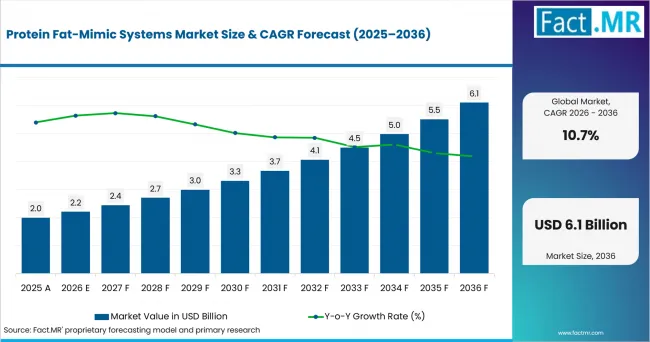
The Protein Fat-Mimic Systems Market is projected to grow significantly, with an estimated value of USD 2.2 billion in 2026 and reaching USD 6.1 billion by 2036, representing a compound annual growth rate (CAGR) of 10.7% over that period.
Read More
The market was valued at USD 2.0 billion in 2025, driven by increasing demand for products that maintain sensory qualities in reduced-fat formulations. Key contributors to this growth include the need for fat-reduction systems that preserve texture in dairy products and sauces, stable body in food applications, and enhanced mouthfeel in plant-based products.
Significant factors influencing market trajectories include an absolute opportunity of USD 3.9 billion expected between 2026 and 2036. Dairy product developers are focusing on fat-reduction systems that can offer a pleasant mouthfeel, and USDA data indicates U.S. whey protein concentrate output reached 502 million pounds in 2025, highlighting the essential role of whey proteins in achieving desired textures in protein-led formulations.
The market's demand is categorized into various segments. For fat-mimic architecture, microparticulated whey is anticipated to hold a 34.0% market share by 2026 due to its ability to create smoothness in reduced-fat dairy. Creaminess, projected to represent a 30.0% share, is vital as fat reduction impacts texture. Moreover, less than 20% fat replacement is forecast to capture 37.0% of the market, supporting easier adjustments to established recipes. Dairy products are expected to account for 33.0% of the food matrix segment in 2026.
Analysts note that successful protein systems are those that maintain desirable textures despite fat reduction challenges. Shambhu Nath Jha, Principal Consultant at Fact.MR, emphasizes the market's inclination towards systems that reliably provide smooth textures at practical fat-cut levels, suggesting a need for thorough practical testing in the development phase.
Growth rates indicate varied regional performance, with the UK projected at an 11.5% CAGR through 2036, Japan at 11.2%, and the USA at 10.9%. Germany is set to achieve a 10.6% CAGR, while France is expected to reach 10.3%. The landscape of this market includes key players such as MicroLub, Tate & Lyle, Leprino Nutrition, IFF, FrieslandCampina Ingredients, and Arla Foods Ingredients, who are critical in establishing the sensory and functional aspects of protein fat-mimic solutions.