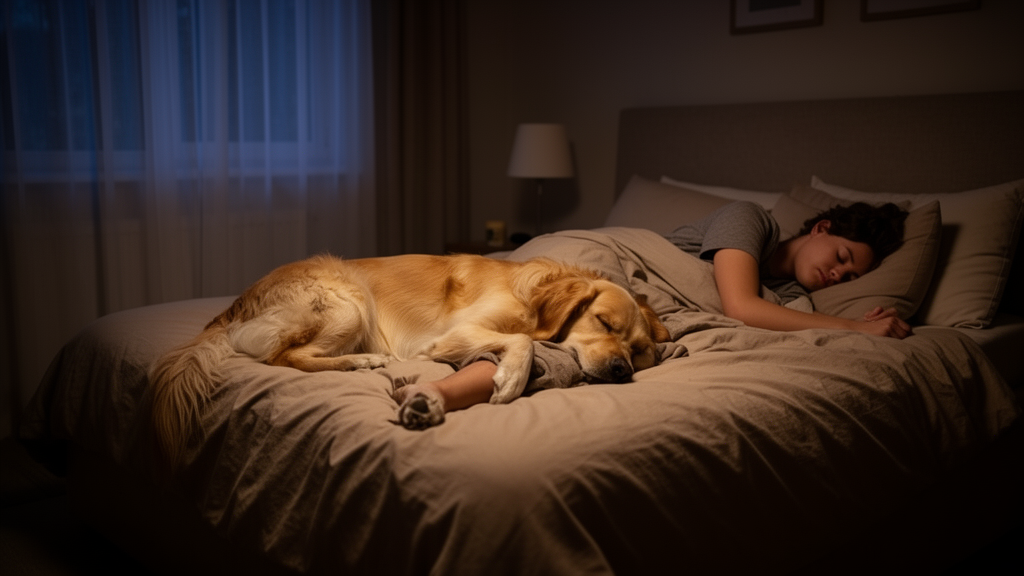
A recent study published on October 7, 2026, in the journal PLOS One investigates the impact of co-sleeping on sleep quality for both dogs and their owners. Led by Ming Fei Li and Lavania Nagendran from the University of Toronto and the University of Toronto Mississauga, the research provides objective evidence suggesting that sharing a bed with a dog does not significantly harm human sleep, contrary to common beliefs among many dog owners.
Read More
Despite widespread anecdotal evidence regarding the mutual influence of humans and dogs on each other’s sleep, previous studies have produced conflicting results. Some have indicated that sleeping with pets can lead to fragmented sleep, while others noted that it might have neutral or even positive effects. To better understand this relationship, the researchers gathered data from 25 people and their 38 dogs. Each participant wore a wrist activity monitor, while each dog wore a collar monitor, allowing for continuous tracking of movement and sleep patterns.
Over four weeks, the monitors revealed a strong correlation between the nighttime activities of humans and their dogs. Both commonly stirred or moved around the same time during the night, which suggests that their sleep is interconnected. Interestingly, the findings indicated that humans typically began moving before their dogs, implying that owners are more often the ones who disrupt their dogs' sleep, rather than the reverse.
Crucially, the study found that sharing a bed with a dog did not significantly affect the sleep quality or duration of the human participants, even if they felt their dogs were disturbing them. This discrepancy between subjective feelings and objective measurements underscores a known phenomenon in sleep research: people often misjudge their sleep quality. The findings suggest that while mutual disturbances occur, they do not detract from the overall sleep quality for either species.
The authors highlighted the need for cautious interpretation, noting that the study involved a limited number of participants with no control group of dog-less individuals. They emphasize that future research should encompass a larger and more diverse sample, including dogs of various ages and breeds, to better assess the nuances of this dynamic.
In conclusion, for dog owners sharing a bed with their pets, the data provide reassurance that they are likely enjoying satisfactory sleep, despite some nighttime disruptions. The study illustrates that while both humans and dogs may rouse each other, the impact on sleep quality appears minimal.