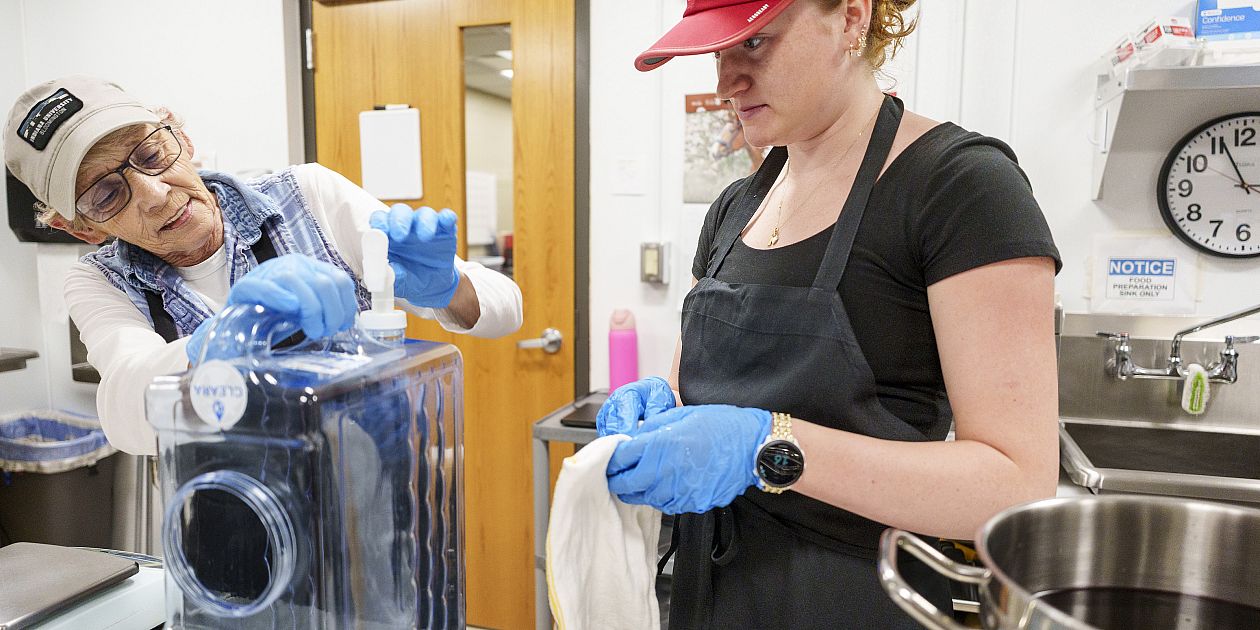
Corrine Nicholson, who began her career at Indiana University Bloomington in 1983 as a cook's helper, returned from retirement to manage the metabolic kitchen. "I was home not quite a whole year and saw a job posting for the metabolic kitchen at the School of Public Health-Bloomington," she said. "I thought, ‘This is everything I've worked my whole life for.'"
Read More
Opened in 2023, the metabolic kitchen at the Indiana University School of Public Health-Bloomington’s Nutrition and Metabolic Research Lab is facilitating advanced studies on various nutritional topics, including the health benefits of beef versus plant proteins, the appeal of Mediterranean versus Midwestern diets, and the impact of ketone supplements on individuals consuming high sodium levels.
The kitchen is part of the Nutrition and Exercise Research Center, which supports scientists engaged in diet-related research. This facility includes a clinical suite for screening participants, a biospecimen processing laboratory, and the metabolic kitchen itself.
Although the science of nutrition is relatively nascent, having only been officially recognized for about a century, significant inquiries remain regarding which nutrients can effectively prevent or manage health conditions. Nana Gletsu Miller, an associate professor in the Department of Applied Health Science, emphasized the importance of randomized clinical trials that allow controlled dietary studies, stating, "Through the research kitchen, IU Bloomington has the unique capacity to conduct these cutting-edge studies, providing a critical resource that distinguishes the university from many other research institutions."
Prior to the establishment of the metabolic kitchen, diet-related research was spread across individual labs. Centralizing this research is advantageous as every study necessitates collaboration among dietitians, student research assistants, and kitchen management to ensure proper food safety and production oversight.
Nicholson brings 40 years of experience from IU's kitchens and dining halls to her role as manager, where she ensures adherence to the highest food hygiene standards. Her expertise extends to creating meals for individuals with allergies and food sensitivities, which is crucial for the metabolic kitchen's mission of producing meals, capsules, and supplements for rigorous nutrition studies.
Lisa Spence serves as the research dietitian at the metabolic kitchen, collaborating with researchers to design controlled diets that study nutrients and dietary patterns. Recently, she created menus for a study comparing the Mediterranean diet to the Midwestern diet, ensuring each dietary pattern contained equivalent macronutrients and micronutrients tailored to participants' caloric needs.
"The reason we have this metabolic kitchen is to ensure accuracy," Spence said. Nicholson meticulously follows Spence's designs for each meal, ensuring not only precision and food safety but also the appeal of the meals to enhance participants' experiences.
The kitchen also plays a vital role in training students within the School of Public Health-Bloomington. Gletsu Miller noted its function as a learning environment for students, who gain insights into the research process and develop professional skills through undergraduate research assistantships.
Students such as Delaney Wigand and Grace Tyson, who previously worked in the kitchen, expressed their enthusiasm for the opportunity, highlighting its relevance to their future careers in dietetics and exercise science. Wigand remarked, "It’s just great coming in and making pancakes for work."
Tyson and Wigand contributed to preparing salt capsules for a study led by Austin Robinson, an associate professor in the Department of Kinesiology, focusing on the effects of dietary sodium on kidney and cardiovascular health. Supported by funding from the National Institutes of Health, Robinson's current study examines whether a liquid ketone supplement can mitigate sodium's harmful effects. He noted the importance of the controlled environment provided by the metabolic kitchen for producing individualized salt capsules.
Robinson appreciates the broader implications of the Nutrition and Exercise Research Center, including its role in facilitating substantial grant applications, and the opportunity for students to engage in meaningful research. "It’s really cool to think that we’re doing important research that has a real impact on people, but we’re also training the next generation of dietitians and healthcare providers," he said.
Resources like the metabolic kitchen drive innovation in health and wellness research. Contributions to the Dean’s Research Fund support ongoing faculty and student research at the School of Public Health-Bloomington, helping to translate new ideas into significant discoveries.