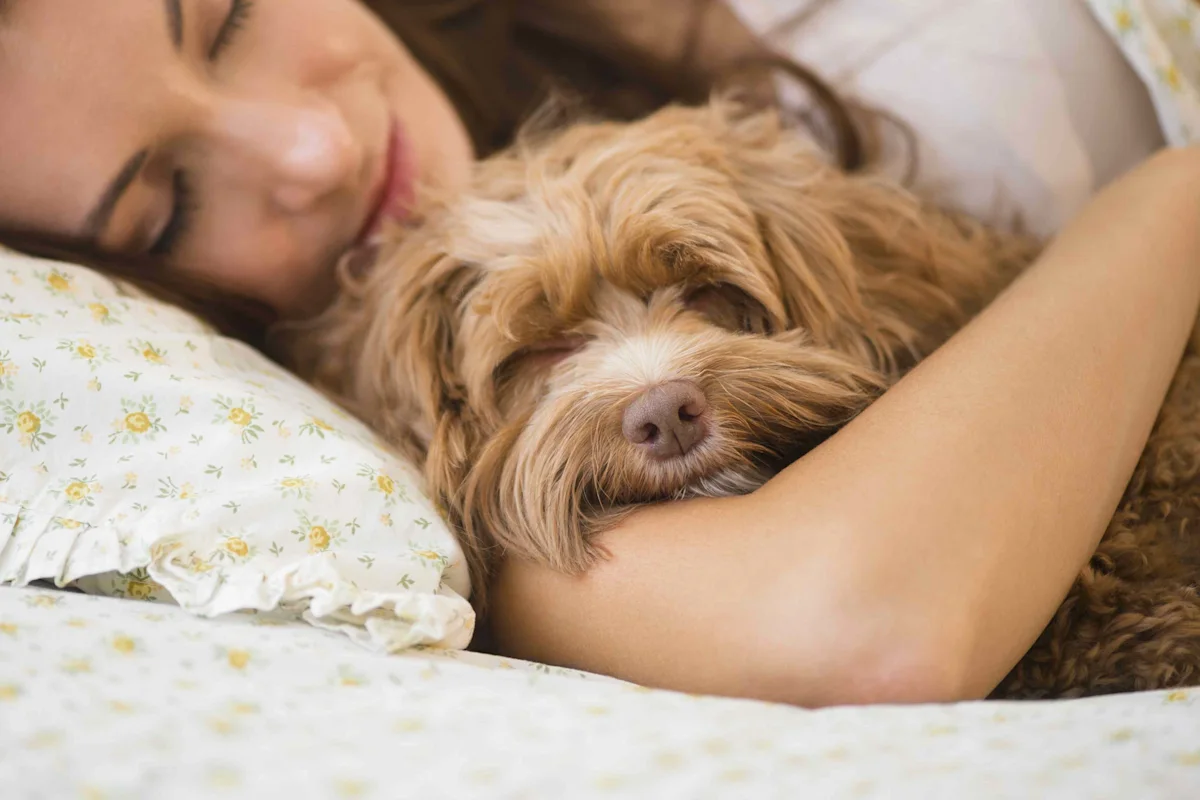
A new study from the University of Toronto Mississauga (UTM) reveals that dogs may not significantly disrupt their owners' sleep, contrary to popular belief. Researchers in the Department of Anthropology published their findings in the journal PLOS One, focusing on the nighttime activity patterns of humans and their pets.
Read More
The study tracked a small group of 25 Canadian dog owners, who collectively had 38 dogs. Both owners and their canine companions wore actigraphy sensors for four weeks to monitor their nighttime movements, providing data on sleep duration and efficiency. Participants also completed surveys regarding their perceived sleep quality.
Results indicated that sleeping alongside one or multiple dogs did not meaningfully affect measured sleep duration or efficiency. However, dog owners with multiple dogs reported poorer sleep quality, suggesting a discrepancy between perceived and actual sleep data.
Furthermore, the study found that human and dog movements were often synchronized, with 61 percent of pairs demonstrating correlated nighttime activity. In 45 percent of these cases, human movement occurred before dog movement, indicating that a disturbance from the owner often prompted a response from the dog. Conversely, only 18 percent of instances showed dogs moving first.
The study highlights the close synchronization between humans and dogs. Lavania Nagendran, a co-author of the study, noted, "We’re sharing our space, and we’re sharing our routines… We’re very much in tune with one another, especially during the nighttime." Additionally, about 72 percent of participants felt safer sleeping with their dogs, which Ming Fei Li, another co-author, suggested may strengthen the bond between humans and dogs based on their shared evolutionary history.
The researchers caution that their study involved a small sample size and did not include a control group of non-dog owners. They advocate for further research involving dogs of various ages and breeds to ascertain the broader applicability of their findings.