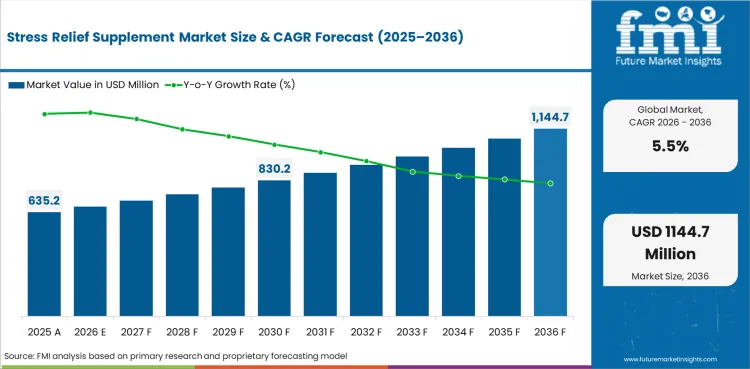
The global stress relief supplement market was valued at approximately USD 635.2 million in 2025, with expectations to grow to USD 670.1 million by the end of 2026. This market is projected to expand at a compound annual growth rate (CAGR) of 5.5% from 2026 to 2036, reaching an estimated USD 1.14 billion by 2036.
Read More
Key drivers of this market include a rising prevalence of anxiety, burnout, and sleep disorders, particularly among working-age populations. There is increasing consumer preference for natural, non-pharmaceutical alternatives, along with heightened awareness of mental wellness following the pandemic.
Ashwagandha is expected to dominate the source segment, holding a 31.5% share in 2026, due to its strong clinical support and consumer recognition as a leading adaptogen. The capsules and tablets form is anticipated to take a 44.2% share, benefiting from ease of use and compatibility with pharmacy distribution channels. Drug stores and pharmacies are projected to lead distribution at 29.6%.
Regionally, India is expected to grow at the highest rate of 6.3%, fueled by extensive ashwagandha production and increasing herbal product consumption. North America will also continue to see sustained demand, supported by an established retail infrastructure and consumer focus on mental health.
The market is evolving from a fragmented category into a more structured segment with increasing clinical validation and regulatory clarity. Brands that successfully combine clinically backed formulations with robust distribution networks are likely to capture significant market share.
The report highlights the importance of adapting to consumer trends towards non-habit forming supplements and expanding product lines to include sleep and cognitive support, thereby enhancing commercial opportunities for established brands.
Additionally, the stress relief supplement market does not encompass prescription medications or products outside the dietary supplement regulatory framework. The methodology for this analysis involved comprehensive primary research and data validation against global nutraceutical production statistics.