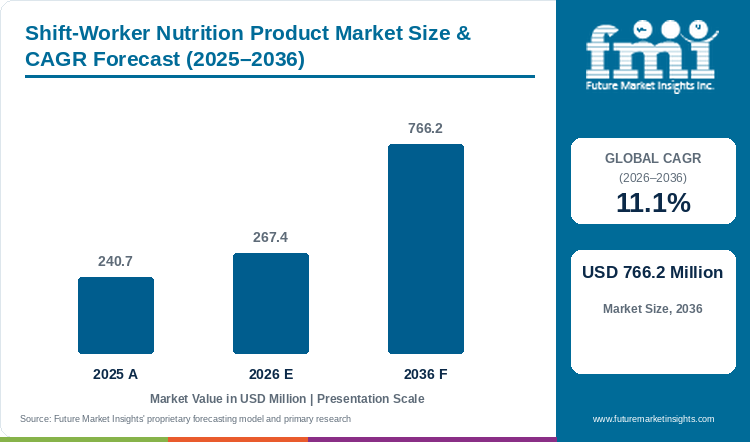
The shift-worker nutrition product market is anticipated to grow from USD 267.4 million in 2026 to USD 766.2 million by 2036, reflecting a compound annual growth rate (CAGR) of 11.1%. The 2025 market value is estimated at USD 240.7 million, indicating a significant increase of USD 498.8 million over the next decade, effectively nearly tripling the market from its 2026 base.
Read More
This market encompasses oral nutritional and functional products specifically designed for managing sleep, maintaining alertness, sustaining circadian rhythms, or addressing gut health issues arising from irregular eating patterns. It excludes prescription medications, routine meal expenditures, employer-sponsored fatigue management services, and products purchased for non-shift-work purposes.
The need for these nutritional products is underscored by the physiological challenges faced by shift workers, whose irregular schedules often disrupt normal sleep patterns and contribute to fatigue, thereby affecting reaction time, attention, memory, and decision-making abilities. The success of these products in achieving repeat purchases largely depends on whether workers perceive tangible benefits and whether the products can be easily integrated into their daily routines.
The specific market is distinct from the broader dietary supplements market, focusing solely on consumers with nontraditional work hours such as night shifts and rotating schedules. Changes in workplace structures, such as redesigned shifts or improved employer fatigue programs, could reduce the necessity for these products as conditions for rest improve.
In the years ahead, the market is expected to expand significantly, with a forecasted CAGR of 11.1%, translating to a 2.87x growth factor over the same period. Notably, South Korea leads growth among profiled countries at a rate of 11.3%, while Japan exhibits the slowest growth at 9.0%.
Melatonin and sleep-timing products are projected to constitute a substantial portion of the market, estimated at approximately USD 113.9 million in 2026, which represents 42.6% of the product category. Concerns regarding label accuracy were highlighted in a 2023 study, indicating that many melatonin products could be inaccurately labeled. This issue is critical, as label integrity is vital for maintaining consumer trust and safety.
Permanent night shifts represent a notable segment of the market, accounting for 49.4% of shift patterns, which translates to about USD 132.1 million in 2026. The healthcare sector is the dominant industry contributor, making up 48.6% of the market at approximately USD 130.0 million.
Gummies are particularly favored among product forms, commanding 44.1% of that segment with an approximate value of USD 117.9 million, while online direct-to-consumer channels represent 48.5% of sales, amounting to roughly USD 129.7 million.
In summary, the shift-worker nutrition product market is poised for robust growth through 2036, influenced by workplace dynamics and consumer demand for products that support sleep and overall health in nonstandard work schedules.