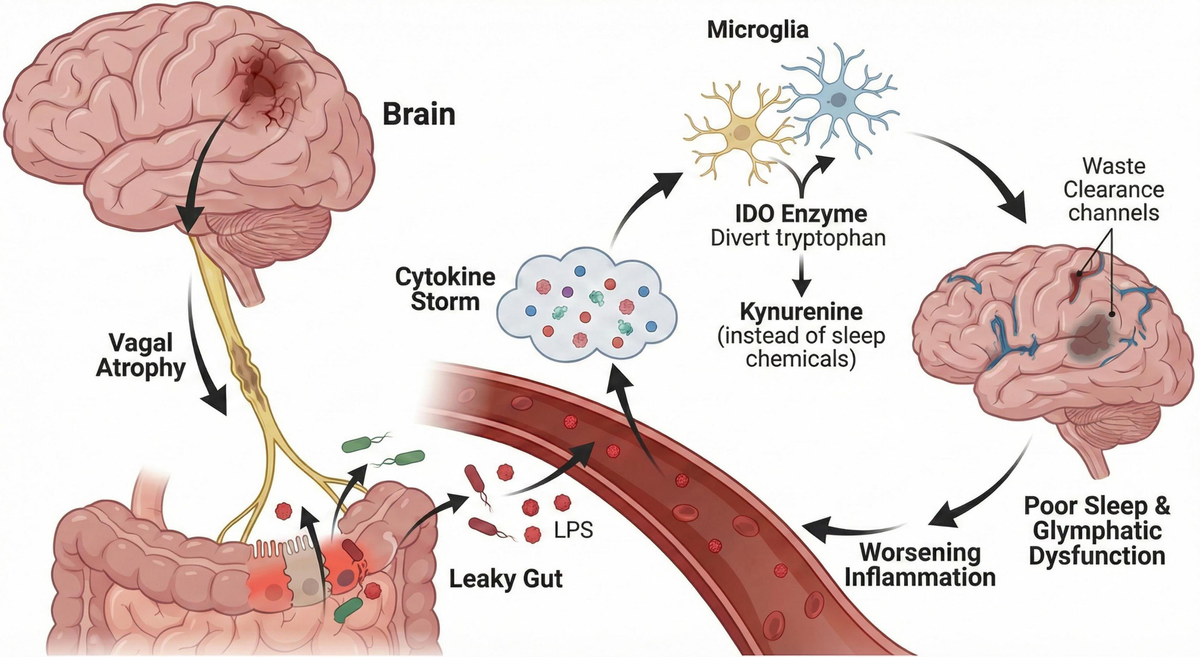
Post-stroke insomnia (PSI) poses a significant barrier to neurorehabilitation, affecting over half of stroke survivors. Traditional sedative treatments often lead clinicians to choose between effectively treating sleep issues and risking cognitive impairment. The microbiota-gut-brain (MGB) axis emerges as a promising focus in addressing this dilemma. Following an acute stroke, the body experiences substantial autonomic dysfunction, resulting in intestinal barrier compromise, a condition known as “leaky gut.” This situation permits the systemic release of lipopolysaccharides (LPS) and activates the NLRP3 inflammasome, leading to systemic inflammation and disruption of central tryptophan metabolism via the indoleamine 2,3-dioxygenase (IDO) enzyme. This process diverts serotonin precursors toward neurotoxic pathways, resulting in severe cortical arousal and sleep disruption, which in turn hampers clearance of metabolic waste through the glymphatic system, contributing to neuroinflammation.
Read More
To tackle this cycle, a phased therapeutic approach is suggested. During the acute phase, interventions must focus on gut barrier protection using postbiotics to reduce infection risks associated with central nervous system (CNS) injury-induced immune suppression. As patients transition to the chronic phase, treatment strategies should shift toward restoring metabolic function employing live therapeutics such as washed microbiota transplantation (WMT) and next-generation psychobiotics, including Akkermansia muciniphila. This targeted strategy offers a mechanistic basis for precision sleep medicine, which is essential for enhancing neuroplasticity and recovery.
Stroke is a leading global health concern, with significant rates of mortality and long-term disability. Recent hyper-acute recanalization therapies have improved early outcomes but have led to a growing number of survivors facing chronic issues, particularly sleep disturbances. Sleep problems, including PSI, are prevalent but frequently overlooked in clinical evaluations, often masked by more evident motor deficits. Epidemiological data indicate that nearly half of stroke survivors experience sleep issues, highlighting the need for proactive recognition and treatment. PSI is characterized not only by difficulties falling asleep but also by frequent awakenings and non-restorative rest, with untreated cases correlating with worse functional recovery and increased risks of adverse vascular events.
Current pharmacotherapy options for insomnia remain inadequate. Many clinicians face challenges balancing effective sleep treatment against the risks associated with GABAergic sedatives like benzodiazepines, particularly in older patients, where their use has been linked to a higher risk of falls and other complications during rehabilitation. Additionally, evidence suggests excessive GABAergic inhibition can impair post-stroke neuroplasticity, necessitating non-sedative-based alternatives that address underlying insomnia mechanisms.
The emerging MGB axis concept serves as a significant paradigm shift in understanding how gut health influences recovery following ischemic stroke. Dysbiosis, characterized by a decrease in beneficial gut bacteria and increased numbers of potentially harmful microorganisms, can lead to systemic inflammation and neuropsychiatric complications. There is increasing recognition that these gut-related changes can underlie the neuroinflammatory responses linked to post-stroke sleep disorders. Notably, the inflammation following stroke is associated with altered tryptophan metabolism, exacerbating neurotoxic conditions relevant to sleep dysregulation.
Sleep disorders encompass various symptoms, yet insomnia following stroke is particularly problematic, with significant persistence beyond the initial event. Polysomnography studies confirm altered sleep architecture, including reduced sleep efficiency and decreased slow-wave sleep, critical for physiological restoration. The glymphatic system, responsible for clearing interstitial waste, operates best during sleep, and disruptions here can lead to worsened outcomes.
Notably, existing research reveals a bidirectional relationship between sleep and stroke; pre-existing sleep disorders can increase stroke risk, and the consequences of stroke can further complicate sleep patterns. Therefore, the need for tailored clinical strategies during recovery emphasizes the importance of examining both gut microbiome profiles and patient-specific factors related to stroke and sleep.
Future research should focus on addressing the clinical and mechanistic complexities outlined, emphasizing the precise timing of interventions based on recovery phases. Transitioning to MGB axis-focused therapies represents a novel opportunity to enhance treatment for insomnia in stroke survivors, potentially supporting their recovery pathways while ensuring patient safety.