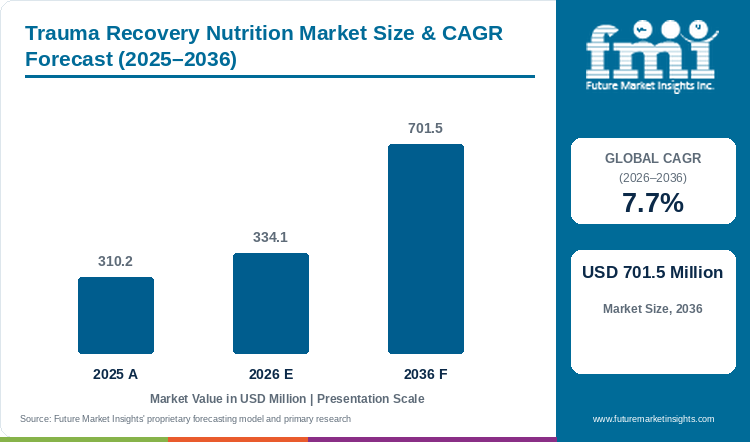
The Trauma Recovery Nutrition Market is projected to grow from USD 334.1 million in 2026 to USD 701.5 million by 2036, representing a CAGR of 7.7% over the period.
Read More
The demand for trauma recovery nutrition is forecast to expand significantly, with estimated growth from USD 310.2 million in 2025 to USD 334.1 million in 2026. Key products included in this market are enteral tube feeds, oral supplements, and protein modules utilized in acute care and rehabilitation settings. In March 2025, Medtrition introduced the ProSource Cup, providing 20 grams of protein in a two-ounce serving, usable both orally and via feeding tubes.
Geographically, growth rates vary, with South Korea expected to increase at an 8.0% CAGR while the UK is projected to achieve a 7.5% CAGR through 2036. South Korea's growth is driven by comprehensive recommendations on energy, protein, and feeding tolerance published by the Korean Society for Parenteral and Enteral Nutrition, while NHS England's trauma registry supports the UK's growth with over a million records of injured patients. Both countries' markets, however, face challenges related to formulary access and necessary documentation.
Key findings indicate that earlier enteral feeding and concentrated protein delivery are boosting demand as they support nutrition after severe injury limits normal oral intake. High-protein, high-energy formulations are expected to comprise 38.3% of the market in 2026. Orthopedic and fracture injuries are predicted to represent 39.9% of injury-type demand, necessitating extended rehabilitation and nutrition support. Enteral tube feeds are anticipated to lead the product type with a 48.5% market share in 2026, primarily due to their measurable clinical delivery.
Significant players in the Trauma Recovery Nutrition Market include Abbott, Nestle Health Science, Danone Nutricia, Fresenius Kabi, Baxter, B. Braun, Victus, and Medtrition, all vying for market share through the development of diverse feeding routes and product formats. Analysts see a shift towards early nutrition selection immediately following stabilization, with ongoing rehabilitation presenting strong adoption opportunities.
Each market segment is characterized by its own dynamics:
- By formulation, high-protein high-energy accounts for the largest share.
- Orthopedic and fracture injuries are the most common injury type requiring nutritional support.
- Enteral tube feeds are crucial for patients unable to ingest food safely after trauma.
- Trauma centers are the leading end-users of these nutrition products, emphasizing the need for targeted feeding strategies during critical recovery phases.
Overall, the Trauma Recovery Nutrition Market is positioned for robust growth, driven by increased awareness of nutritional needs in trauma care and advancements in product offerings.