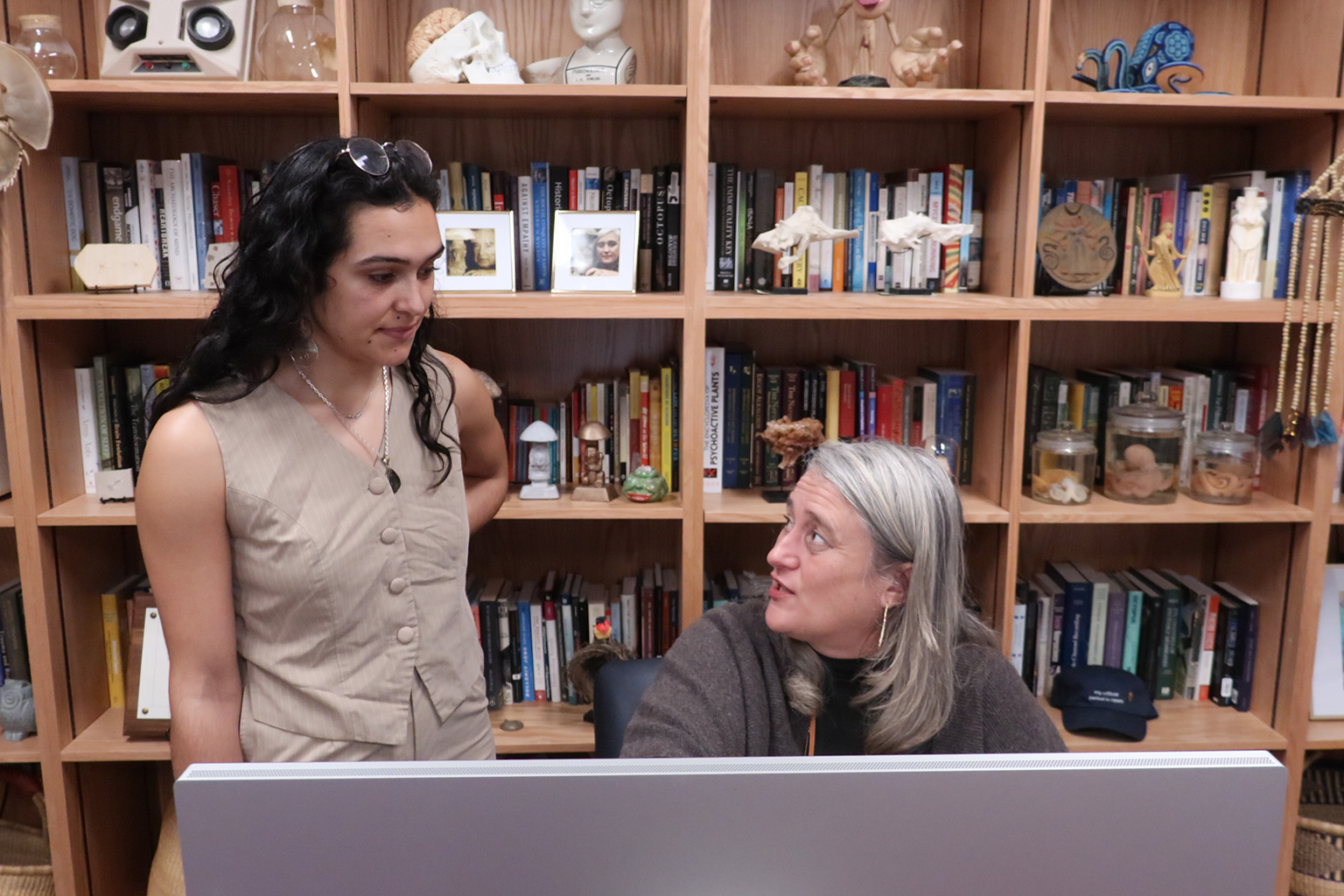
Professor Gül Dölen joined the University of California, Berkeley's neuroscience and psychology departments in January 2024, and has since transformed her lab and office into a vibrant research space featuring dinosaur brain replicas, an extensive bookshelf, colorful floor tiles, and Beatles posters. She remarked, "I daydreamed of having this office for my whole career; finally, I've got it."
Read More
Despite the renovations, the team has been active, conducting various experiments. Notably, graduate student Kenz Wilkinson was busy running tests during a recent visit, while research technician Dominick Dickerson responded to a lab emergency. Dölen has also been in discussions with the Drug Enforcement Agency to secure a license for working with psychedelic medicine.
Dölen is recognized for her research on critical periods in brain development, which are limited windows when neural circuits can be shaped by experiences. These critical periods are essential for learning skills such as language and motor control. In 2019, Dölen's team found that the psychedelic drug MDMA could reopen these critical periods, thereby enhancing learning and memory for extended periods. Subsequent research indicated that this effect is consistent across various psychedelics, leading Dölen to explore rehabilitative applications.
On February 9, her lab initiated a clinical trial involving stroke patients facing motor impairment. Participants receive controlled doses of psychedelics and engage in a motion-capture video game designed to facilitate recovery. One activity requires patients to simulate piloting a dolphin, encouraging extensive arm movements necessary for regaining motor skills. This innovative approach holds promise as a new strategy for stroke rehabilitation.
Dölen is the Bob & Renee Parsons Endowed Chair in psychology and neuroscience. Bob Parsons, a businessman and Vietnam War veteran, sought treatment for post-traumatic stress disorder (PTSD) after reading Michael Pollan’s 2019 book, "How to Change Your Mind." Following his positive experience with psychedelics, the Parsons established a faculty position at UC Berkeley focused on the intersection of psychology, neuroscience, and psychedelics, leading to Dölen's recruitment.
Dölen aims to use the reopening of critical periods to help individuals with PTSD reframe fear-based responses into healthier ones. Her 2019 study showed that MDMA led adult mice to engage more socially, a behavior commonly seen in juveniles. This finding may enhance trust in therapists and willingness to engage in therapy, critical elements in addressing PTSD.
"Psychedelics aren't a magic pill that cures all diseases by themselves," Dölen stated. "They’re adjunct therapies that enhance the effectiveness of other treatments by restoring the brain's ability to learn. In cases like PTSD and depression, pairing psychedelics with psychotherapy is appropriate, while for motor impairments, combining psychedelics with motor therapy is ideal."
Dölen's academic background includes an M.D./Ph.D. degree, with her most recent position at Johns Hopkins University School of Medicine. Her move to UC Berkeley has also allowed her to expand her studies on octopuses, which were previously a minor focus of her research. With new funding from the Steven and Alexandra Cohen Foundation and the Silicon Valley Community Foundation, her team is now actively exploring octopus biology.
The lab aims to create a comprehensive atlas of an octopus, offering insight into its complex nervous and cardiovascular systems. Dölen features a digitally rendered image from this project as a captivating screensaver in her office. The lab employs advanced equipment, including fluorescence microscopes for studying limb regeneration and patch-clamp electrophysiology rigs for studying brain neuron activity. Dölen explained, "This approach provides both the highest spatial and temporal resolution to record neuron activity, revealing the mechanisms at play."