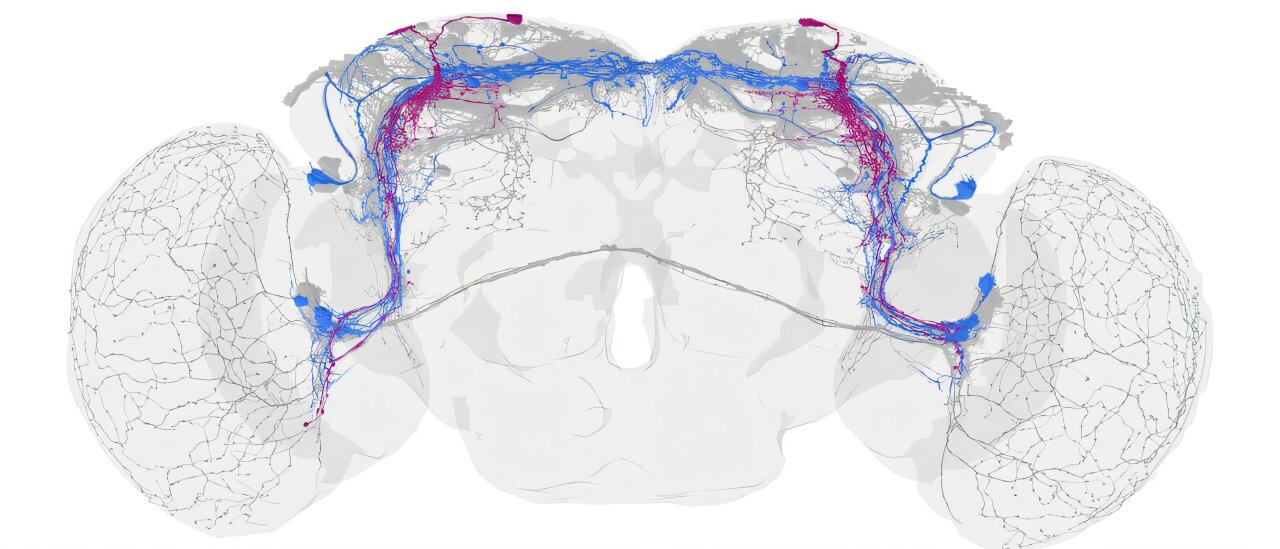
A new study from researchers at the University of Würzburg has found that a minimal neural network consisting of just four specialized neurons is sufficient to govern the circadian rhythms of the fruit fly, Drosophila melanogaster.
Read More
All living organisms possess an endogenous clock that helps them align their behaviors and physiological functions with the natural cycle of day and night, known as the circadian rhythm. In fruit flies, this intricate clock network usually comprises approximately 240 neurons, whereas mammals, including humans, possess tens of thousands.
Traditionally, it was believed that particular neurons on the sides of the brain served as the primary pacemaker for the entire system. However, the recent findings indicate that a small group of clock neurons is actually responsible for timekeeping, with other neurons capable of taking on the pacemaker role.
Prof. Charlotte Förster, the lead researcher, and Dr. Nils Reinhard, the first author of the study, conducted experiments wherein they deactivated 236 clock neurons in the fruit fly's brain, leaving only four neurons active. Surprisingly, these four neurons alone maintained the fly's typical activity patterns—exhibiting activity peaks in the morning and evening, even without external cues.
This discovery challenges existing models of the circadian clock by demonstrating that the previously assumed primary pacemakers are not essential for measuring time. Additionally, the researchers identified the signaling pathways these four neurons utilize, employing the neuropeptide CCHamide-1 (CCHa1) for morning activity and the classic neurotransmitter glutamate for evening activity.
Furthermore, the study reveals that these four neurons belong to a broader network of 18 neurons that are already formed in the larval stage of the fly. This suggests that a 'core clock' is established early in development, capable of producing fundamental circadian rhythms in adult flies. Additional neurons that develop later likely serve to refine this core clock, enabling the fly to adapt its behavior to various environmental conditions.
By merging two previously competing theories, the research suggests that the circadian clock possesses both a clear hierarchy in pacemaking roles and flexible properties for adaptation. Reinhard posits that this organizational principle may be a common framework for biological time measurement across various species.
These findings are a significant step in understanding circadian clock networks, as they indicate that increasing complexity in these systems during development is not unique to fruit flies; similar patterns have been observed in other insects and mammals.
The study, published in the Proceedings of the National Academy of Sciences, marks important progress in chronobiology and helps deepen our comprehension of how circadian rhythms function.