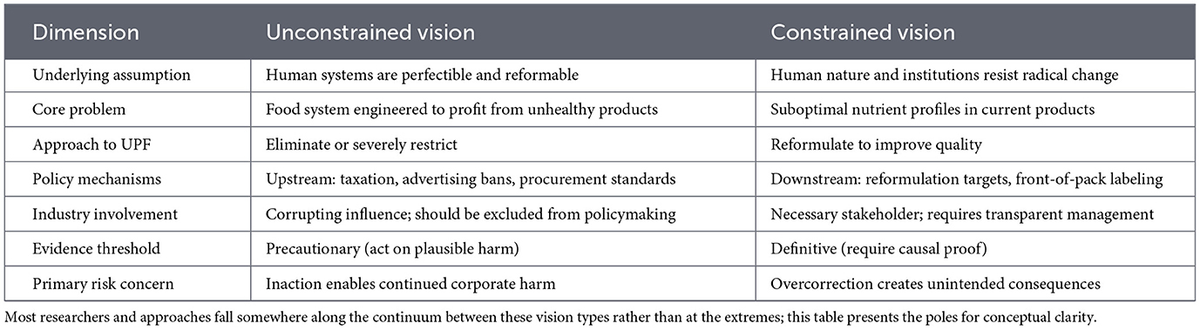
As society grows increasingly polarized over various scientific issues, from vaccinations to ultra-processed foods (UPF), the debates often overshadow nuanced perspectives. This polarization can complicate public health decision-making, as institutional challenges and competing interests hinder consensus. The framework of Thomas Sowell's "A Conflict of Visions" sheds light on why certain disputes, like those surrounding UPF, persist. Different visions of human nature and societal progress influence how researchers frame questions, interpret evidence, and develop solutions, making these disagreements more than mere technical debates.
Read More
The evolving landscape of scientific discourse, driven by metrics and rapid publication cycles, has shifted debates toward public advocacy. This has blurred the lines between generating evidence and persuading the public, often intensifying polarization. Social media plays a significant role in this dynamic, with simplified messaging and moral framing shaping how scientific ideas are communicated and received. Consequently, substantial disagreements over UPF emerge, reflecting broader ethical and empirical convictions about public health and food systems.
The discord centers on competing perspectives regarding the food industry. Supporters of the UPF concept propose that systemic reform is necessary, likening modern food production to past tobacco industry practices that prioritize profit over health. They call for drastic changes to combat what they perceive as a broken system. In contrast, critics argue for reformulating existing products to enhance their nutritional quality rather than restructuring the entire food system.
These contrasting views manifest in policy recommendations: proponents of the unconstrained vision advocate for measures such as taxation and advertising bans, while those with a constrained vision prefer targeted reforms like labeling and product improvement. This spectrum of beliefs shapes the perceptions of integrity within the scientific community, especially regarding industry funding and its implications for research credibility.
Each side interprets industry ties differently: proponents of the unconstrained vision view such collaborations as corrupting influences undermining scientific integrity, while supporters of the constrained vision see them as a pragmatic necessity that requires effective management. This dichotomy reflects a deeper ideological divide, where the interpretation of evidence is often filtered through personal and social identities, stifling constructive debate and slowing necessary policy advancements.
While polarization can occasionally spotlight neglected issues, it also impedes balanced discourse. Strong opinions can overshadow curiosity, limiting dialogue and allowing biases to amplify unchecked convictions. Therefore, fostering a more open environment that values debate over certainty is essential for revitalizing scientific inquiry and public health initiatives.
Various strategies could help address these issues, such as adversarial collaborations that bring researchers from opposing viewpoints together to co-design studies. This could help surface hidden assumptions and mitigate confirmation bias. Encouraging scientific journals and institutions to prioritize reflexivity and nuanced takeaways may also reshape engagement dynamics in science.
Ultimately, acknowledging biases and the influence of power structures within academia and the industry is crucial for maintaining scientific credibility. Although systemic change is necessary, fostering a culture of openness and critical inquiry within existing frameworks could significantly enhance public health dialogue and decision-making.