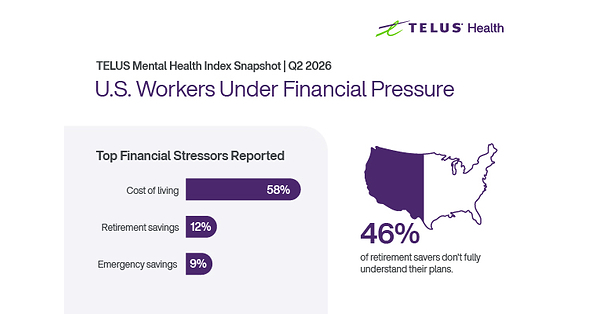
A report from TELUS Health’s Mental Health Index for Q2 2026 indicates that 58 percent of US workers cite the cost of living as their primary financial concern, significantly overshadowing worries about retirement savings (12 percent) and emergency savings (9 percent). The report also highlights a troubling lack of understanding among workers regarding their retirement benefits, with 46 percent admitting they do not fully grasp the plans they contribute to each month.
Read More
The findings show a large connection between financial wellbeing and workplace productivity, with one in seven US workers stating financial stress impacts their job performance. Nearly two-thirds (64 percent) report feeling anxious about money, and one in nine workers never stop worrying about their finances. Additionally, 23 percent lack emergency savings, and those without such savings are three times more likely to report declines in productivity.
Paula Allen, Global Leader of Research and Insights at TELUS Health, stated that for many workers, immediate survival concerns have taken precedence over long-term financial planning. She noted that 15 percent of workers feel their personal financial stress directly affects their productivity, while 3 percent have missed work due to financial issues.
Younger workers, parents, and caregivers are particularly vulnerable to financial stress. Workers under 40 are three times more likely than those over 50 to report productivity declines due to financial anxiety. Working parents experience twice the likelihood of reporting productivity losses from financial strain, and 27 percent of workers, referred to as the 'Sandwich Generation,' provide financial support to aging parents or adult children, often experiencing negative impacts on their own finances and mental health.
The survey data, collected from 5,000 employed adults in the US between June 5 and June 18, 2026, reflects a balanced demographic representation. The Index uses scores ranging from 0 to 100 to present mental health status, with scores below 50 indicating distress.
Only 49 percent of workers feel comfortable discussing mental health issues with their managers, which aligns with a broader stigma that affects care-seeking behaviors in the workplace. Key barriers to seeking help for substance-related issues also include costs and fears of workplace repercussions.
Overall, the TELUS Mental Health Index shows that financial stress is a critical issue affecting the mental health of the US workforce, contributing to lower productivity and an urgent need for improved support resources from employers.