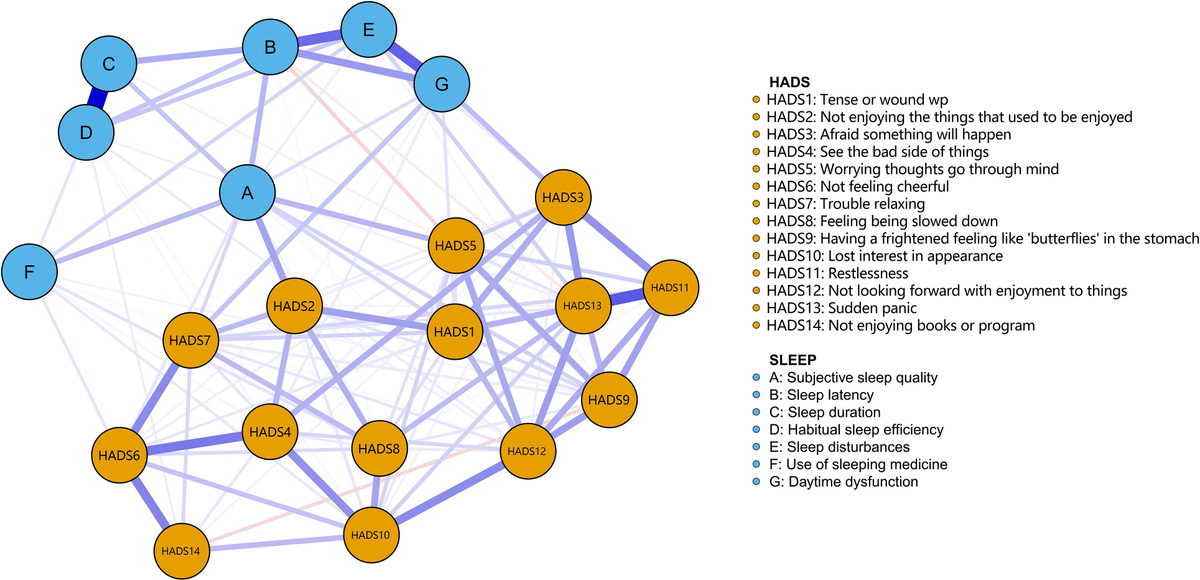
Objective: Recent research highlights the simultaneous occurrence of sleep disturbances and mental health issues in cardiac patients. However, the interplay among these symptoms within chronic heart failure (CHF) patients has not been extensively studied. This research utilized network analysis to identify pivotal symptoms among patients.
Read More
Methods: A cross-sectional study was conducted involving 406 CHF patients at a hospital in Nanning, Guangxi, China, from August 2024 to March 2025. Participants completed questionnaires detailing their health and quality of sleep, specifically using the Pittsburgh Sleep Quality Index (PSQI) for sleep evaluation and the Hospital Anxiety and Depression Scale (HADS) for anxiety and depressive symptoms. Network analysis was conducted through Gaussian Graphical Models (GGM) in R software to assess symptom interrelations. Symptoms' centrality and bridging capabilities were evaluated.
Results: The analysis identified high centrality for HADS12 (not looking forward with enjoyment to things) and HADS13 (sudden panic), with scores of 1.205 and 1.208 respectively, establishing them as key nodes. PSQI-A (subjective sleep quality) was identified as a crucial bridge symptom with a bridge expected influence score of 0.541, linking sleep issues with psychological symptoms.
Conclusions: The findings highlight the critical symptoms within the CHF symptom network, suggesting potential for targeted interventions to improve treatment outcomes and quality of life among these patients, particularly those facing comorbid anxiety and depression.
Introduction: Chronic heart failure significantly impacts over 56 million people globally, with expectations for a 46% increase by 2030, posing major public health challenges. Sleep disorders, characterized by poor sleep quality, affect roughly 85.8% of CHF patients, aggravating issues such as anxiety, depression, and declining physical health.
Previous findings show a notable prevalence of anxiety (approximately 30%) and depression (around 21.5%) among CHF patients, likely attributable to lifestyle changes and uncertainty about their condition. The relationship between sleep quality and mental health is reciprocal, as poor sleep can exacerbate anxiety and depressive symptoms, intensifying the overall burden on patients.
The novel network analysis approach offers a comprehensive view of symptom interactions compared to traditional statistical methods, enabling a more detailed understanding of the core and bridging symptoms in this context.
Materials and Methods: This investigation aimed to document demographic and clinical characteristics alongside the interrelations among symptoms utilizing standardized questionnaires. The study population consisted of various socio-demographic backgrounds, ensuring a robust sample size for network analysis.
Results indicated a significant overlap of poor sleep quality (57.39%), anxiety (60.34%), and depressive symptoms (73.15%) in participants, highlighting the pressing issue of mental health within this population. A detailed investigation of symptom scores indicated notable correlations suggesting a complex underlying system of relationships.
In summary, the study effectively captures the interconnectedness of sleep quality, anxiety, and depressive symptoms in chronic heart failure patients. Recognizing these connections will assist in developing targeted treatment strategies, which may include cognitive behavioral therapy and modifications to improve sleep quality. This research underscores the necessity for more integrated healthcare approaches focusing on both physical and mental health care for CHF patients.