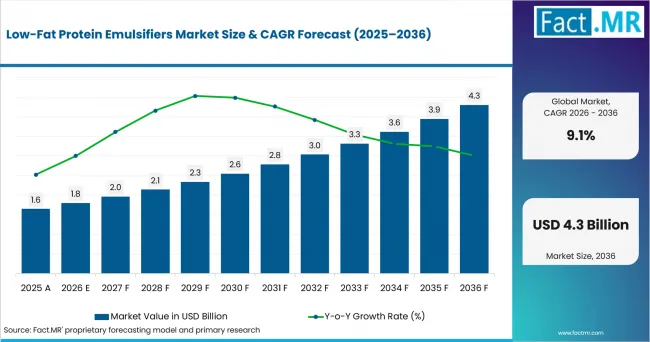
The Low-Fat Protein Emulsifiers Market, valued at USD 1.6 billion in 2025, is projected to grow to USD 1.8 billion in 2026 and reach USD 4.3 billion by 2036, reflecting a compound annual growth rate (CAGR) of 9.1% from 2026 to 2036. This growth is driven by the increasing demand from beverage, dairy, and sauce manufacturers who utilize proteins to enhance texture and stability in reduced-fat products.
Read More
By 2036, there is an anticipated absolute opportunity of USD 2.5 billion, predominantly from whey, oil-in-water systems, fat-free applications, and beverages. Formulators in the beverage industry particularly require proteins that maintain oil dispersion in low-fat drinks, following a USDA Economic Research Service report indicating food spending in the United States reached USD 2.51 trillion in 2025. Dairy companies benefit from whey and other proteins to achieve a smooth texture in low-fat products, while sauce manufacturers rely on protein functionality to minimize separation and formulate pourable sauces.
Market segmentation analysis indicates that by 2026, whey is expected to command a 35.0% share as the leading protein source due to its nutritional value in dairy products. The oil-in-water emulsion system is projected to capture a 31.0% share, while fat-free applications are estimated to hold a 36.0% share, addressing formulation requirements post-fat removal. Beverages are forecasted to account for 34.0% of the end product market in 2026, indicating the need for stable protein systems in lower-fat drinks.
S.N. Jha, Principal Consultant at Fact.MR, emphasizes the necessity for food manufacturers to ensure that proteins retain functionality after fat reduction, suggesting that suppliers who provide reliable mixing and pleasant taste profiles may see increased demand.
Geographically, the UK, expected to grow at a CAGR of 10.1%, will lead the market, followed by Japan at 9.7%, and the USA at 9.4%. Germany and France are anticipated to grow at rates of 9.1% and 8.8%, respectively.
Key players in the market include Kerry Group and Arla Foods Ingredients, who focus on dairy protein functionalities, and Ingredion, Cargill, IFF, and Roquette, which enhance plant-protein capabilities. These companies are anticipated to compete based on taste, blendability, and functionality during processing, as the demand for low-fat food products continues to climb.