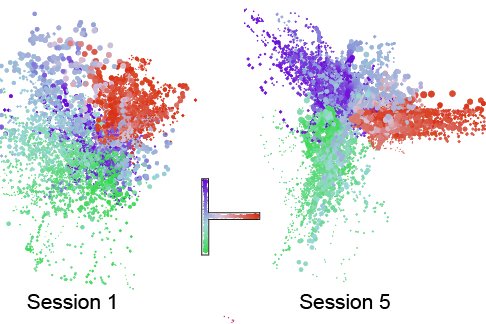
A recent study by MIT neuroscientists at The Picower Institute for Learning and Memory has shed light on how the brain develops cognitive maps of spaces and underscores the vital role of sleep in this process. The research indicates that while day one of exploring a new environment yields many memorable spots, it often takes days for those memories to coalesce into an intuitive understanding of the area.
Read More
The study focuses on the hippocampus, a brain region known for its role in remembering specific locations through cells called “place cells,” which activate in response to particular places. However, to create a cohesive cognitive map of the broader environment, the brain must integrate the activity of these place cells.
Published in the December edition of Cell Reports, the study finds that the construction of these maps relies on subtle changes in the activity of cells that are only weakly attuned to individual locations. Over days, these cells enhance the hippocampus's ability to encode entire spaces, especially when coupled with sleep. Lead author Wei Guo noted that while on the first day the brain may not effectively represent the environment, by the fifth day, it begins to develop an integrated map.
To reach these conclusions, Guo and senior author Matthew Wilson, along with their colleagues, observed mice navigating through simple mazes over several days without any rewards for specific behaviors. This allowed them to evaluate the mice's natural tendency for latent learning, revealing how they internalized the maze layouts. They monitored the neurons' activity in the CA1 area of the hippocampus during exploration and sleep, leveraging a technique that highlighted neuron activation linked to calcium ion build-up.
The researchers discovered that while place cells exhibited strong and consistent activity, changes in weakly spatial cells were critical for evolving cognitive maps. These cells, not tuned to specific locations, began to connect activity patterns among other neurons, effectively linking various places into a comprehensive map.
Further experiments assessed the necessity of sleep for enhancing cognitive maps. Mice that were allowed to sleep after exploring two mazes on the same day demonstrated significantly better refinement of their mental maps compared to those deprived of sleep. Sleep appeared to enhance neurons' sensitivity to specific places and their corresponding activity patterns.
Guo emphasized that the resulting cognitive maps, while not exact duplicates of the spatial layout, provided a mental representation to navigate environments without physical exploration. Wilson suggested that the weakly spatial cells might encode additional non-spatial information, enriching the map's meaning.
This study illustrates the capacity for implicit and unsupervised learning in animals, which could parallel aspects of human cognition. The research was funded by the Freedom Together Foundation, The Picower Institute, and the National Institutes of Health.