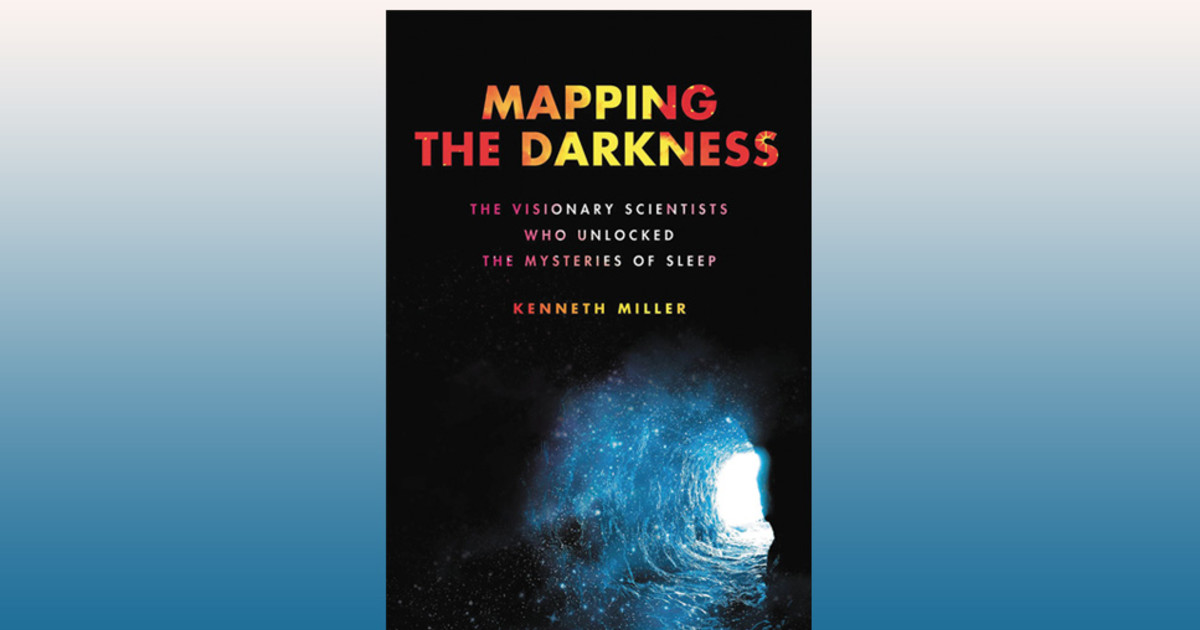
Kenneth Miller ’83JRN presents an in-depth exploration of sleep science in his book, Mapping the Darkness. He discusses the modern obsession with understanding sleep and its impact on daily life, highlighting the global focus on sleep research.
Read More
Today, the field is supported by major research institutes, thousands of sleep disorder clinics, and a multibillion-dollar industry offering a variety of products aimed at improving sleep health. For many, monitoring sleep quality has become as simple as wearing a smartwatch that analyzes REM cycles overnight.
Historically, knowledge of sleep was minimal. Miller notes that a century ago, our understanding of the unconscious state was virtually nonexistent, despite spending a significant portion of our lives asleep. He details the contributions of four pioneering scientists who transformed sleep research: Nathaniel Kleitman, Eugene Aserinsky, William Dement, and Mary Carskadon.
Kleitman, regarded as the “patriarch” of sleep science, overcame numerous obstacles, including widespread antisemitism, to focus on sleep, a subject neglected by other researchers. His early studies involved primitive experiments, including a month spent in a cave to observe natural sleep cycles without external stimuli.
In the early 1950s, Aserinsky, Kleitman’s assistant, utilized early brain-mapping tools to identify the REM state, demonstrating that the brain remains active during sleep. Although this discovery didn't lead to a PhD for Aserinsky, it was pivotal in advancing sleep science. Kleitman's other protégé, Dement, established the first sleep clinic at Stanford University, where he linked dreaming to REM cycles and explored neural activity during sleep. Carskadon, initially sidelined in the male-dominated field, gained recognition for her research on adolescents' sleep needs, influencing educational policies in the 1980s.
Miller emphasizes the critical importance of sleep beyond wellness trends. High-profile disasters, such as the Challenger explosion and the Exxon Valdez oil spill, have been attributed in part to sleep deprivation. Furthermore, modern technology exacerbates sleep issues, with digital devices making it challenging to disconnect from waking life. The blue light emitted from screens can disrupt our circadian rhythms, complicating our need for rest.
While much remains unknown about sleep, Miller’s account of these four scientists illustrates the essential role sleep plays in our lives and the challenges they faced in advancing scientific understanding.