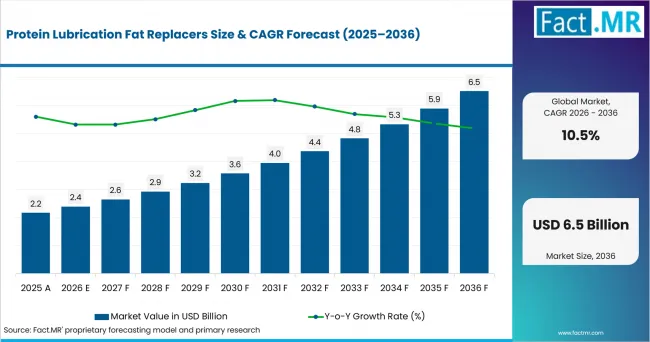
The Protein Lubrication Fat Replacers Market reached a value of USD 2.2 billion in 2025, with projections indicating an increase to USD 2.4 billion in 2026 and further growth to USD 6.5 billion by 2036, reflecting a compound annual growth rate (CAGR) of 10.5% between 2026 and 2036.
Read More
Demand for protein lubrication fat replacers is driven by the need for proteins that can restore texture following fat reduction in various food applications. For instance, dairy and alternative dairy producers require proteins like whey that can maintain smoothness, while beverage manufacturers need proteins that mix well and contribute to a desirable mouthfeel without adding graininess.
In the warehouse of opportunities, the market is expected to see an absolute growth of USD 4.1104 billion through the forecast period. Dairy and alternative dairy teams particularly rely on proteins for maintaining creaminess, and the production of whey protein isolate in the U.S. was recorded at 213.524 million pounds in 2025.
Key segments show that whey proteins are anticipated to hold a 34.0% market share in 2026, while lubrication and creaminess are projected to account for 31.0%. By application, dairy and its alternatives are expected to capture the largest share at 36.0%. Additionally, powder concentrates are forecast to represent a 29.0% share by format.
According to Shambhu Nath Jha, Principal Consultant at Fact.MR, the challenge of fat reduction centers on achieving the right texture. Teams are constantly evaluating the balance between creaminess, smoothness, and emulsion stability while optimizing for higher protein use, which can sometimes lead to undesirable qualities like chalkiness.
Geographically, the USA and France are predicted to achieve an 11.3% CAGR through 2036, with China and Germany following closely at 11.1%. Japan is expected to see a growth rate of 10.0%. Various market forces influence these trends, including local food costs and protein supply.
By analyzing the key players in the market, companies like Kerry Group, MicroLub, and Arla Foods Ingredients are highlighted for their expertise in providing protein-based solutions that address texture, taste, and operational performance in food applications.