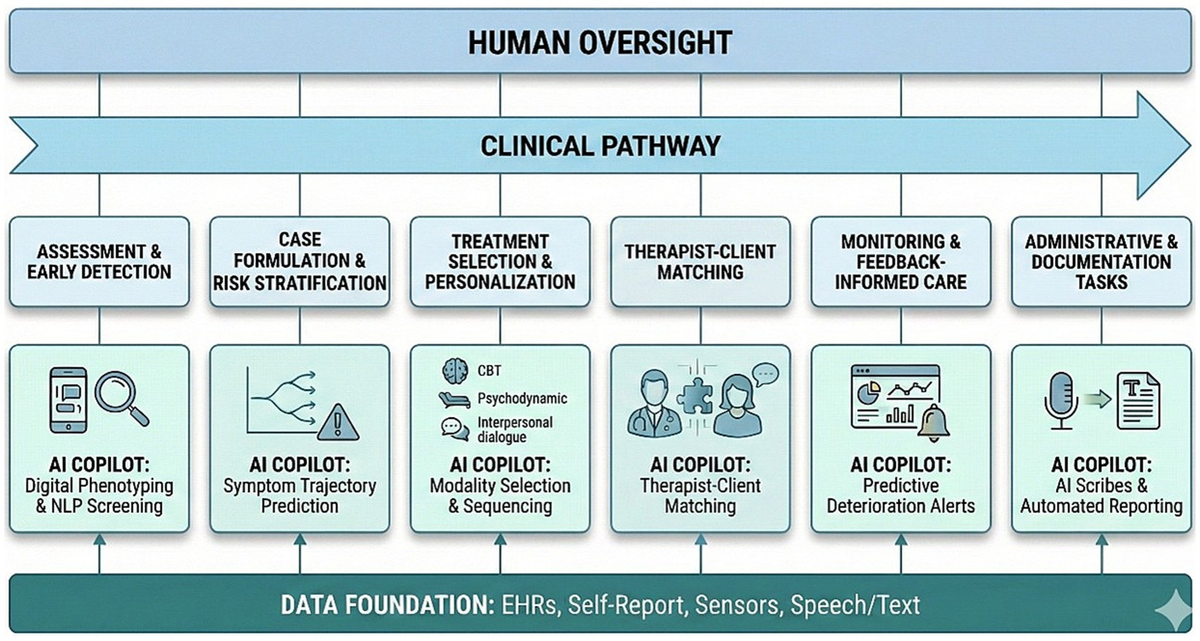
Artificial intelligence (AI) is transforming the practice of psychology, impacting assessment, case formulation, intervention planning, monitoring, and documentation. However, professionals face a decision: to use AI as a fully automated ‘therapist’ or as a supportive tool that enhances clinical judgment, maintaining the vital relational and ethical elements of psychological care.
Read More
This article explores how contemporary AI technologies, especially machine learning and large language models, align with psychologists’ essential tasks. It discusses the potential this integration has for improving clinical quality and scalability, as well as presenting Psypilot as a case study in the development of AI as a clinical assistance platform aimed at Precision Mental Health.
Key challenges and risks associated with AI use in this context include automation bias, fairness, privacy concerns, and accountability under evolving regulatory frameworks. The authors offer practical recommendations for the design and training of AI systems, promoting the view of AI as a support tool in decision-making processes rather than a replacement for human psychologists.
In light of the increasing demand for mental health services, cited by a World Health Organization report indicating that over one billion people suffer from mental health conditions, the need for innovative solutions is clearer than ever. Current investment in mental health remains modest, with only around 2% of health budgets allocated to this area, leading to significant treatment gaps, particularly in Europe, where estimates suggest nearly 45% of those with serious mental illnesses do not receive adequate care.
AI has made significant strides in healthcare, demonstrating capabilities that match or surpass those of specialists in fields like dermatology and diabetic retinopathy screening. As similar advancements are made in mental health, the concept of Precision Mental Health emerges, aiming to tailor interventions more precisely to individual patient needs based on systematic data rather than generalized practices.
AI applications in psychology include enhancements in assessment and early detection of mental health issues, risk stratification, personalized treatment selection, patient-therapist matching based on empirical data, and enabling feedback-driven, measurement-based care. By integrating AI into existing workflows, clinicians can leverage AI's analytical power while retaining control over the therapeutic process.
The choice between substitutive AI—where patients may interact directly with automated systems without the involvement of human professionals—and AI copilots, which aid psychologists in their clinical work, presents ethical implications. Implementing AI as a copilot reinforces the role of psychologists as primary decision-makers, using AI to enhance, rather than supplant, their expertise.
Psypilot exemplifies this approach, offering functionalities that streamline assessment and treatment planning while emphasizing the importance of the therapist-client relationship. With a focus on precision, Psypilot provides tools that can follow established psychological assessment protocols, operationalizing precision-oriented care while addressing related governance and ethical challenges through designed safeguards.
The development and implementation of AI in mental health require careful consideration of safety, accountability, fairness, explainability, and legal compliance. Features that ensure data privacy and oversight are crucial in maintaining trust between psychologists and their clients. Moving forward, the integration of AI in psychological practice should be guided by principles that prioritize human oversight and the ethical delivery of care.