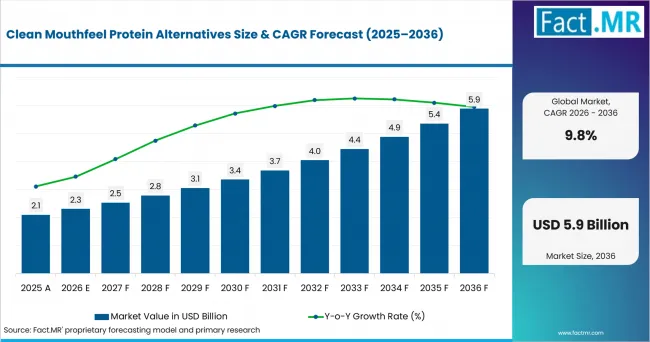
The Clean Mouthfeel Protein Alternatives Market is expected to grow from USD 2.3 billion in 2026 to USD 5.9 billion by 2036, with a compound annual growth rate (CAGR) of 9.8%. The market was valued at USD 2.1 billion in 2025.
Read More
The growth is driven by the demand for protein enrichment in various food sectors, particularly dairy, beverages, bakery, and plant-based products, while maintaining a creamy texture and smooth mouthfeel.
Analysts estimate an absolute opportunity of USD 3.6 billion in the market by 2036.
Key segments analyzed include:
- **Protein Platform**: Whey proteins are expected to account for 34.0% of the market share in 2026 due to their proven nutritional benefits and versatility in dairy and nutrition applications.
- **Functional Role**: Lubrication and creaminess are projected to make up 31.0% of the market share as manufacturers seek protein systems to provide body and smoothness to lower-fat products.
- **Application**: Dairy and dairy alternatives are forecast to capture 36.0% of the market in 2026, underscoring the importance of mouthfeel in enhanced recipes.
- **Format**: Powder concentrates are expected to hold a 29.0% share in 2026, valued for their flexibility in storage, dosing, and application across various food types.
Analyst Shambhu Nath Jha from Fact.MR highlighted that success in the market hinges on maintaining familiar textures in finished products, emphasizing the need for protein systems that offer smoothness without roughness.
Geographically, China is projected to experience the fastest growth at a CAGR of 10.7% until 2036, supported by expanding food processing and dairy production. Japan follows with a 9.6% CAGR driven by health-focused food trends, while the U.S. and France are estimated at 9.2% CAGR due to their established food industries.
The report also notes the challenges faced by the market, including taste roughness and recipe costs, which may hold back broader adoption of clean mouthfeel protein alternatives. In contrast, the demand for better taste and nutrition in food products is likely to accelerate uptake.