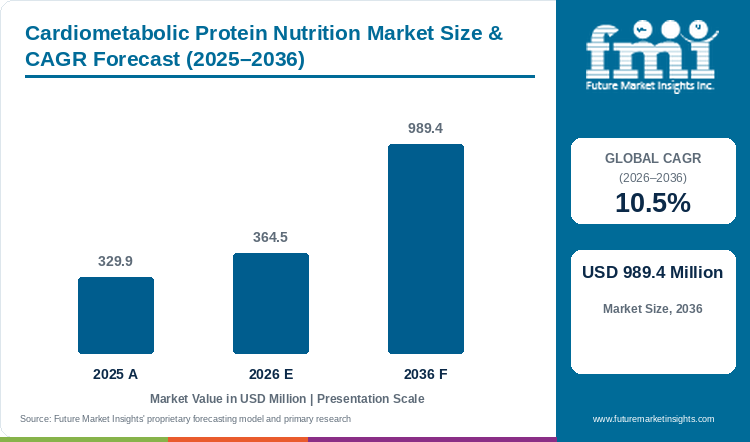
The cardiometabolic protein nutrition market is projected to grow from USD 364.5 million in 2026 to USD 989.4 million by 2036, representing a compound annual growth rate (CAGR) of 10.5% from 2026 to 2036. This growth is driven by increasing consumer demand for products that assist in managing weight, blood sugar, and cholesterol levels.
Read More
The Centers for Disease Control and Prevention reported 40.1 million Americans with diabetes and 115.2 million adults with prediabetes in 2026. Given these statistics, nutrition products such as powders, shakes, and snacks with fixed servings are expected to promote repeat consumption. According to Future Market Insights, the market value is anticipated to rise from USD 329.9 million in 2025 to USD 364.5 million in 2026, with an increase to USD 989.4 million expected by 2036.
Demand for cardiometabolic protein nutrition products varies by region. South Korea is estimated to experience a CAGR of 10.6% from 2026 to 2036, faster than the USA's projected 10.2%. In 2025, 34.4% of South Korean adults were classified as obese, and 65% participated in weight-management activities. Digital purchases are helping widen availability, while the USA benefits from strong distribution networks.
Key trends indicate a growing preference for clear labeling, allowing consumers to easily compare sugar, fat, fiber, and serving size. However, taste and price remain significant barriers to frequent use of these products.
By product type, heart-smart protein shakes are projected to dominate with a 44.8% share in 2026, attributed to their ease of consumption and controlled nutrition in single servings. Plant-based protein blends are expected to account for 49.6% of the protein source segment, reflecting a consumer shift toward plant-based diets. Cholesterol management is anticipated to constitute 48.8% of health claim focus due to increasing awareness around saturated fat and sugar content.
The cardiometabolic nutrition market is segmented into various categories based on product type, protein source, health claims, form, and distribution channels. Online sales or direct-to-consumer strategies are projected to capture a significant 41.5% share of the market by 2026, as they provide consumers with detailed product information and convenient delivery options.
Notable companies in this market include Abbott, Nestle Health Science, Danone, Huel, OWYN, Premier Protein, Quest Nutrition, Orgain, and Supergut, all contributing to a diverse range of protein nutrition solutions tailored to cardiometabolic health needs.